-
New case studies available
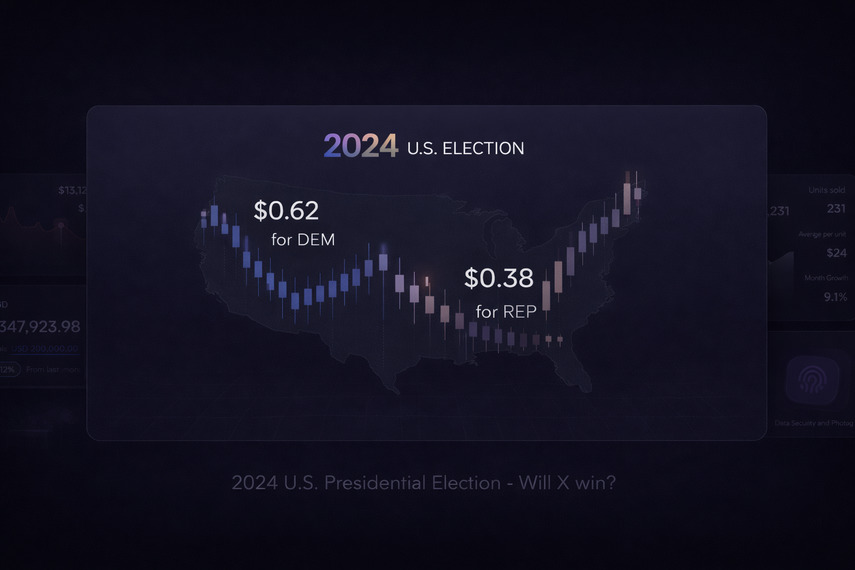
Quantifying aggregated prediction market data.
Using aggregated data to find spreads in volatile markets and gain from arbitrage opportunities in prediction markets.
-
IDEN AI
Revolutionize arbitrage through LLM
IDEN AI is designed to enhance the identification of arbitrage opportunities by identifying semantic mismatches — situations where two markets describe the same real-world event using different wording.
Automate Repetitive Tasks
Use of large language models to contextualise markets and identify markets with the same outcome.

Liquidity calculator
Most prediction markets have very limited liquidity. To avoid that the positions placed move the market too much, we built a liquidity calculator.

Predict volatility
The highest spreads are found in the most volatile markets. IDEM AI predicts future market volatility by utilising large language models to analyse sentiment.

Analyse all markets
IDEN AI analyses all major prediction markets, so you do not miss any arbitrage opportunity.

Improve Team Performance
Built in team module to collaborate on markets.
-
Case study
Learn from our case studies
We regularly publish case studies with arbitrage results.
MrBeast Team water
A great example of a spread within the same prediction market website. Polymarket listed a multi choice market and a single Yes/No market regarding the fact how much MrBeast will raise, or if he will raise $40M by 31 August 2025. It was possible to buy both options for a total of $0.93.
Who will be the next Pope?
This is a historic example of good arbitrage with relatively high liquidity for a prediction market.
Pietro Parolin: 35.2¢ (Myriad) Luis Antonio Tagle: 30¢ (Polymarket) Other: 32.7¢ (Myriad) Total: 97.9¢
OpenAI AGI
Open AI AGI event arbitrage is a low liquidity market. But we managed to get a 21% APY on this exact market in 2025.
More case studies?
For more case studies please contact us directly as [email protected]
-
Acro
Across all major betting market platforms
We integrated all of the biggest prediction markets to ensure, our tool can guarantee the most arbitrage possibilities.
Automate Your Workflow Effortlessly
Polymarket API integration.
Gain Actionable Insights Instantly
Analyze real-time data from all your platforms in one place. Identify arbitrage opportunities.
-
FAQ
Frequently Asked Questions
Understanding arbitrage can be hard, especially when applying to new technologies like prediction markets.
What are prediction markets?
Prediction markets are financial platforms where people trade contracts tied to real-world events — such as elections, sports outcomes, or economic indicators. Each contract’s price reflects the collective probability of an event happening.
For example, if a “Candidate X wins” contract trades at $0.65, the market implies a 65% chance that Candidate X will win.
What is prediction market arbitrage?
Arbitrage in prediction markets occurs when the same event is priced differently across platforms.
For instance:
On Platform A, “Candidate X wins” trades at $0.65
On Platform B, it trades at $0.70
By simultaneously buying low and selling high, we can lock in risk-free or low-risk profit, regardless of the outcome.
PrimeResearch uses automated systems to detect and act on these discrepancies within milliseconds.
What are “spreads” in prediction markets?
A spread is the difference in price for the same event across two (or more) prediction markets.
For example:
On Polymarket, a “Yes” contract for “Will Candidate X win the election?” might trade at $0.60.
On Kalshi, the same contract might trade at $0.65.
That $0.05 difference is called a spread.
It exists because markets are driven by different participants, liquidity, and information — which sometimes leads to temporary pricing mismatches. temporary pricing mismatches, this is more commonly seen in volatile small markets.
How can PrimeResearch find more arbitrage opportunities?
PrimeResearch uses a combination of data science, machine learning, and large language models (LLMs) to uncover arbitrage opportunities that most traders miss.
While traditional arbitrage focuses on numerical price differences, we also look for semantic mismatches — situations where two markets describe the same real-world event using different wording.
For example:
On one platform, a market might ask: “Will Candidate X win the 2028 U.S. election?”
On another, it could be phrased as: “Will Candidate X become President in 2029?”
Even though these are linguistically different, they refer to the same underlying outcome.
Our large language models analyze market descriptions, event metadata, and timelines to identify when two contracts are actually equivalent — even if phrased differently.
By matching these related events across multiple platforms, PrimeResearch can detect hidden arbitrage opportunities that purely numerical systems overlook.
This blend of language intelligence and quantitative analysis gives us a unique edge in the fast-evolving world of prediction markets.
Our team will answer all your questions. We ensure a quick responses.